An open ISA
No license for the instruction set, no single owner, many silicon vendors. A machine expected to run for 15 years should not depend on one supplier's roadmap.
European RISC-V Industrial Computing Initiative
RVA23 silicon has arrived. The industrial computer built on it has not. ERICI brings firmware, hypervisor, real-time and general-purpose operating systems together into one open reference stack, so that RISC-V can run the machines, lines and plants of tomorrow.
Why now
Today's industrial computers run on x86 and Arm: two instruction sets, each owned and licensed by a single company. RISC-V is open, governed by a non-profit, and implemented by many vendors. Until recently it lacked what industrial systems need. That has changed.
No license for the instruction set, no single owner, many silicon vendors. A machine expected to run for 15 years should not depend on one supplier's roadmap.
The RVA23 profile, ratified in October 2024, makes the hypervisor and vector extensions mandatory. Software can rely on them on every compliant chip.
The first RVA23 SoCs and boards are available in 2026, with eight 64-bit cores and an IOMMU. Developers can buy them today.
A partitioning hypervisor runs real-time control and the operator's Linux side by side, isolated from each other, on one SoC.
So why are there no RISC-V industrial computers yet? Board makers wait for software, software waits for boards, and customers wait for both. ERICI breaks that loop with an open reference stack running on real hardware.
The gap
The first RVA23 machines are on the market: eight 64-bit RISC-V cores, the hypervisor extension, an IOMMU. They are excellent development and edge platforms. An industrial computer has to do more: survive the control cabinet, talk to the field, and stay available for a decade or longer.
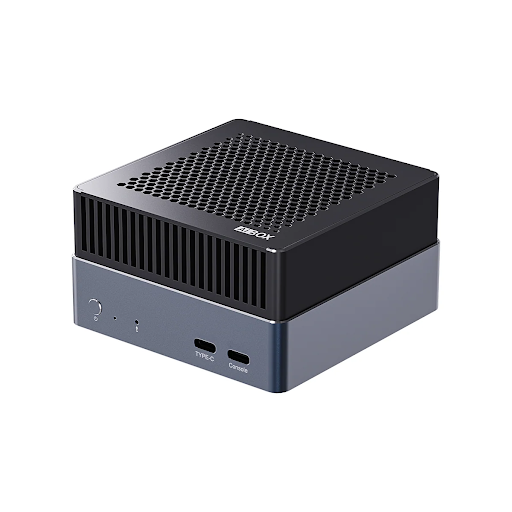
T-Chip Intelligent Technology · edge mini PC
Image © T-Chip Intelligent Technology Co., Ltd. · product page
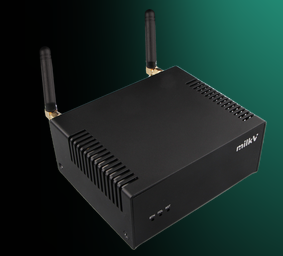
Milk-V · single-board computer, metal case
Image © Milk-V · product page
| Requirement | AIBOX-K3 | Jupiter2 |
|---|---|---|
| RVA23 SoC with hypervisor extension and IOMMU | Yes | Yes |
| 24 V DC supply, wide input range | 9–20 V | 12 V / USB-PD |
| Extended temperature, −40 to 85 °C | −20 to 60 °C | Not stated |
| Fieldbus and real-time I/O (EtherCAT, CAN, TSN) | Not stated | Via modules |
| DIN-rail or panel mounting | Not stated | Not stated |
| Hardware watchdog, isolated digital I/O | Not stated | Not stated |
| Industrial EMC and safety certification | Not stated | Not stated |
| Long-term availability, 10–15 years | Not stated | Not stated |
| Partitioned software stack: real-time next to Linux | Not yet | Not yet |
Specifications as published by the manufacturers, October 2026. Both products are shown as examples of RVA23 hardware available today. No affiliation with ERICI or endorsement by the manufacturers is implied.
The missing pieces are not the cores. They are the industrial hardware around them and an open, partitioned software stack on top. That is where ERICI starts.
Reference stack
A RISC-V Industrial Computer is built in layers. ERICI shows one complete stack running on real RVA23 hardware, but no layer is mandatory: each one can be replaced by the option that fits the application, the certification path or the team's experience.
Bao is a static partitioning hypervisor: each guest gets its own CPUs, memory and devices. QBao extends it with a module loader using Multiboot3. The boot loader loads the hypervisor and the images of every partition as modules, then hands over control. Real-time and Linux partitions start side by side, each with its own share of the SoC.
# hypervisor
multiboot3 qbao.elf
# real-time partition: QSOE/N kernel + root fs
module3    skimmer.bin
module3    qsoe-root.cpio
# operator partition: Linux
module3    vmlinuz
module3    initrd-linux.cpio.gz
boot
Join
ERICI is in its founding phase. Companies and institutions that see RVA23 as the future of industrial computing are welcome to join now and shape the initiative from the start.